Thyroid emergencies exist on two extremes of the spectrum. Although they are uncommon, thyroid emergencies carry disproportionately high mortality and share a crucial management principle: when able to make a clinical diagnosis, treatment cannot wait for confirmatory laboratory values. This blog reviews the physiology, quick recognition, and management of both thyroid storm and myxedema coma.
Background
Thyroid hormone production is controlled by the hypothalamic-pituitary-thyroid axis. The hypothalamus releases Thyrotropin releasing hormone (TRH), which stimulates the anterior pituitary to secrete thyroid-stimulating hormone (TSH), which in turn drives the thyroid gland to produce thyroxine (T4) and triiodothyronine (T3). Circulating thyroid hormone feeds back to suppress both TRH and TSH to keep the system in balance. T4 is the predominant secreted hormone however is physically inactive. T3 is the biologically active form, generated largely from peripheral deiodination of T4.
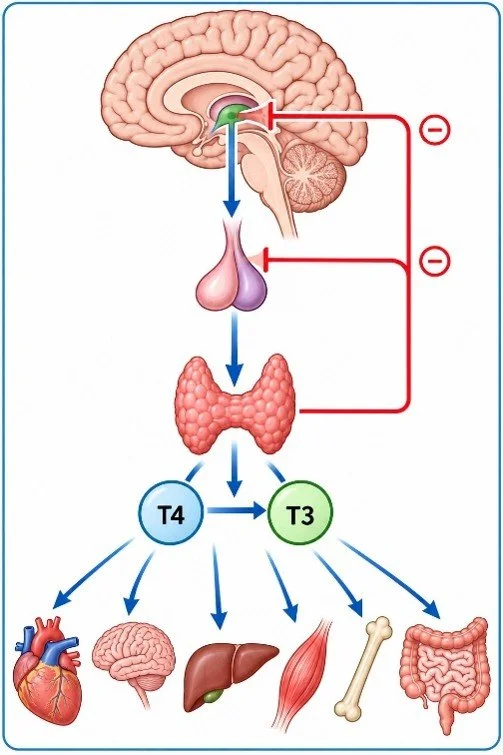
Hypothalamus-Anterior Pituitary- Thyroid Hormone Axis, AI-generated using OpenAI ChatGPT
Thyroid hormone affects virtually every organ system but most pertinently the heart, central nervous system, autonomic nervous system, gastrointestinal tract, and overall metabolism.
Metabolism: Increases the basal metabolic rate of nearly all tissue and drives thermogenesis.
Heart: Upregulate sensitivities to catecholamines increasing heart rate, contractility and cardiac output.
Lungs: Stimulate central respiratory drive.
CNS: Modulates alertness and mood.
Autonomic system: drives its sympathetic tone [1].
Because this hormone is so pervasive, both critical deficiency and excess have a risk for developing multiorgan dysfunction.
Incidence and Mortality
Both emergencies are relatively rare in the United States population however carry a high mortality risk. Thyroid Storm has an incidence of roughly 0.57 to 0.76 cases per 100,000 people per year. Reported mortality ranges from 1.2% to 3.6% in larger studies, however, have been noted to be up to 25% in smaller case series [2]. Myxedema Coma is less common and is roughly reported to have an incidence of 2.56 cases per 1,000,000 people per year in the US. Mortality has fallen over time to increasing rapid recognition but still range from about 6.7% to 29.5% in studies [2].
Hyperthyroid Emergency: Thyroid Storm
This is the decompensated, life-threatening extreme state of thyroid hormone excess. Excessive circulating T3 hormone leads to increased adrenergic response, hypermetabolic processes, and multiorgan dysfunction [3].
Most common triggers [2,3]
Irregular use or discontinuation of antithyroid drugs is the most common precipitant.
Infection.
Historical factors/other causes: Most will have a history of Graves disease, but other causes include thyroiditis, toxic solitary adenoma, toxic multinodular goiter, autoimmune thyroiditis, amiodarone use, lithium use.
Clinical Findings/Diagnosis:
Thyroid Storm is an exaggeration of hyperthyroid symptoms plus decompensation of metabolic, cardiovascular, CNS, and GI systems [3]. The classic triad is altered mental status, hyperthermia, and tachycardia. However, changes to mentation are sometimes the only finding that distinguishes thyrotoxicosis and this decompensated state. It has also been shown to be independently associated with mortality. There is also often gastrointestinal/hepatic dysfunction that can present as nausea, vomiting, diarrhea, jaundice. In addition, relative adrenal insufficiency is also common given the hypermetabolic state leading to decreased cortisol stores [3].
Lab Findings:
Low TSH, high T3/T4 [2]. However, there are no thyroid hormone thresholds that distinguish Thyroid Storm from uncomplicated hyperthyroidism. These values are not profoundly different from those in a compensated state. They can help confirm diagnosis when clinical suspicion is high but do not diagnose storm. Treatment should typically begin independently of these values if suspicion is high [3,4].
Scoring Tools:
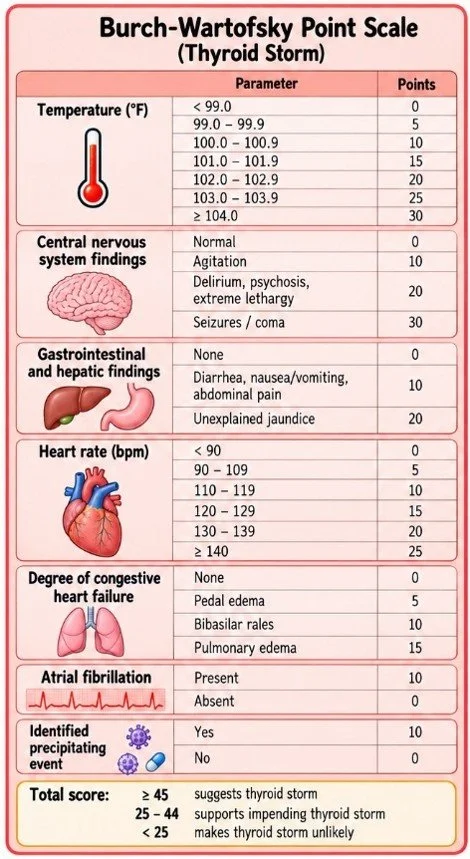
Bursch Wartofsky Point Scale, AI-generated using OpenAI ChatGPT
Burch-Wartofsky Point Scale (BWPS): This scale assigns points based on thermoregulatory dysfunction, cardiovascular features (tachycardia, heart failure, atrial fibrillation), GI slash hepatic dysfunction, CNS disturbance, and a precipitating history [5,6].
< 25: unlikely to be thyroid storm. Other causes of presentation should be investigated. Manage symptoms as needed.
25-44: suggestive of impending storm. Consider initiating treatment for thyroid storm and manage symptoms as needed.
≥ 45: Highly suggestive of a thyroid storm. Rapid and aggressive management for this should be started.
This tool has been shown to be sensitive but not specific so overtreatment is a risk [2]. This can be used as a decisional aid that can supplement, not replace clinical gestalt.
Management:
The overall goal is to reduce circulating hormone while preventing end-organ damage. The sequence of intervention matters [3-5].
Thioamides: Propylthiouracil (PTU) and Methimazole (MMI). These medications inhibit thyroid peroxidase, which therefore blocks new hormone synthesis
Guidelines favor using PTU over MMI because PTU also has ability to inhibit peripheral conversion of T4 to T3, offering further decrease in circulating hormone [5]. However, more recent data has found no significant outcome difference. This is heavily debated and often institution dependent.
In pregnant individuals, there are preferred agents due to fetal and maternal risks.
PTU is preferred over MMI during 1st trimester pregnancy due to teratogen risk.
MMI is preferred over PTU in 2nd/3rd trimester pregnancy due to hepatotoxicity [5].
PTU: 200–250 mg q4hr.
MMI: 20 mg q4-6hr [4].
2. Beta blockade: Used to control response to catecholamines and are titrated to a target heart rate and blood pressure [4].
Propranolol is first line: 60-80mg PO q4-6hr or 0.5-1mg over 10 minutes followed by 1-2mg over 10 minutes every few hours.
Esmolol loading dose of 250 to 500 mcg/kg, followed by an infusion at 50 to 100 mcg/kg per minute.
3. Steroids: Blocks the release of T4 from the thyroid and further reduces conversion of T4 to T3, treat associated adrenal
insufficiency, and potential underlying autoimmune process.
Hydrocortisone 300mg IV loading dose followed by 100mg IV q8hr.
Dexamethasone 2mg IV q6hr.
4. Iodine: Blocks the release of preformed hormone. This must be given at least 1 hour after the first thioamide dose to prevent iodine from serving as a substrate for new hormone synthesis
Potassium iodide (SSKI): 5 drops PO q6hr
Potassium iodide–iodine (Lugol's) solution: 10 drops PO TID
Supportive measures such as cooling measures, Tylenol, and benzodiazepines can also be considered for symptom management [4].
Disposition: These patients will likely require ICU admission due to instability [4].
Hypothyroid Emergency: Myxedema Coma (also known as decompensated hypothyroidism)
The core derangement is profoundly low intracellular T3, which severely decreases metabolism, thermogenesis, and CNS [3,7]. In addition, long standing hypothyroidism leads to accumulation of glycosaminoglycans in the interstitium of skin, intestine, lungs, muscle, and renal medulla produces the characteristic nonpitting edema and contributes to baseline organ dysfunction [3].
Common triggers:
Most common triggers include cold exposure, with roughly 40% of cases occur during winter, infection, discontinuation of medication, and infection [3].
Other common causes: Myocardial infarction, opioids use, amiodarone use, lithium use, and bariatric surgery [7].
Clinical Findings
The diagnosis is largely clinical, resting on the triad of altered mental status, hypothermia, and a precipitating factor in a hypothyroid patient. Of note, despite the name, frank coma is not required for diagnosis [7]. However, most patients will present with some degree of altered mental status. In addition, this is more commonly seen in older women.
Other findings include:
Myxedematous appearance: nonpitting edema; waxy, dry, puffy skin.
Hypothermia (thermogenesis depends on T3).
Bradycardia and hypotension.
Adrenal crisis: Hyponatremia, hyperkalemia, hypoglycemia. This is due to the decreased production of cortisol.
Hyponatremia: from adrenal crisis and kidney dysfunction.
Reduced respiratory drive [3].
Lab Studies:
Similar to Thyroid Storm, thyroid testing does not reliably determine when to treat while a patient is in a decompensated patient. A high TSH and low T3/T4 can be used to support diagnosis but you do not need to wait [2].
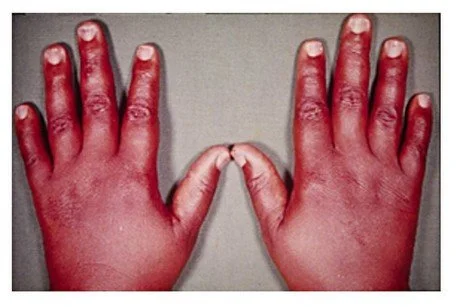
Examples of Myxedema https://commons.wikimedia.org/wiki/File:Myxedema.jpg
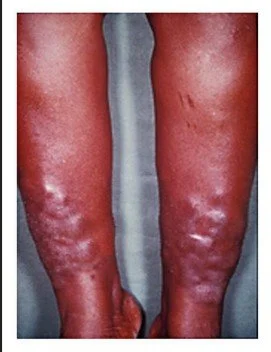
Examples of Myxedema https://commons.wikimedia.org/wiki/File:Myxedema.jpg
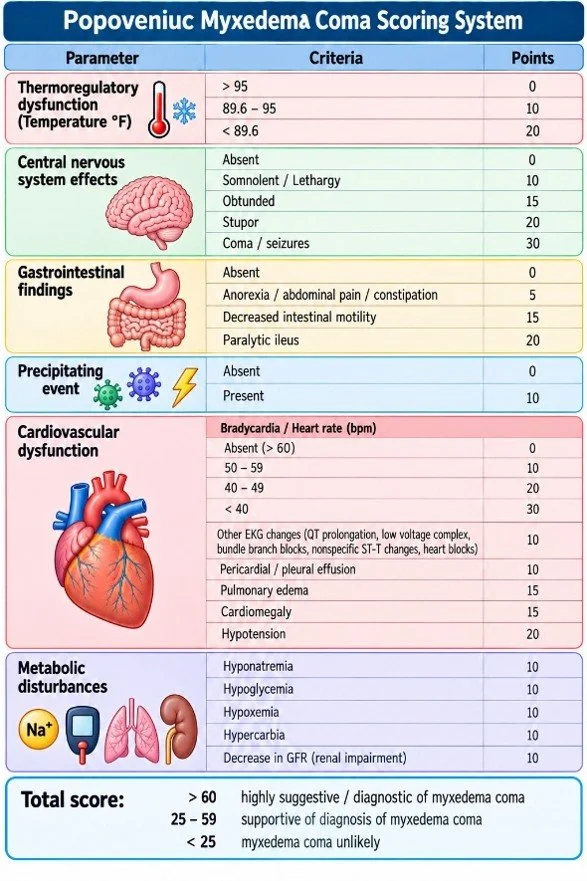
Myxedema Coma Scoring System, AI-generated using OpenAI ChatGPT
Scoring Tools:
Myxedema Coma Diagnostic Score [8]: Scoring system based on thermoregulatory dysfunction, CNS effects, GI symptoms, cardiovascular dysfunction, precipitating events, and metabolic disturbances. A score ≥60 is potentially diagnostic, while a score between 45–59 identifies patients at risk. This tool is not validated to make a diagnosis but can be used as a decision aid to support clinical gestalt.
Management [3,7]
Glucocorticoids: Given due to concomitant adrenal insufficiency. This is ideally before thyroid hormone, to avoid precipitating adrenal crisis
Hydrocortisone 100 mg IV q8hr.
IV thyroid hormone replacement: The choice between T4 and T3 is debated given the lack of clinical trials. (7) Levothyroxine (T4) is slower acting with longer half-life but has fewer side effects. Liothyronine (T3) has a faster onset but carries risks of arrhythmia and MI from an abrupt T3 rise. Combination therapy can also be considered.
Levothyroxine: 200–400 mcg IV load, then 50–100 mcg daily.
Liothyronine: 5–20 mcg IV, then 2.5–10 mcg q8hr.
Supportive care.
Passive rewarming: active rewarming risks vasodilation and worsening hypotension
IV fluids/Pressor support
Airway protection, depending on level of mentation
Empiric antibiotics
Manage sodium and complications of hyponatremia closely
Disposition: These patients will likely require ICU admission due to instability [7].
Post by: Samantha Shulhan, md
Dr. Shulhan is a PGY-1 in Emergency Medicine at the University of Cincinnati
Editing by: Ryan LaFollette, MD
Dr. Ryan LaFollette is an APD in Emergency Medicine at the University of Cincinnati and Co-editor of Tamingthesru.com
CO-Editing by: Haley Escheman, mph
Haley is a Program Administrator at the University of Cincinnati College of Medicine
References
Shahid MA, Ashraf MA, Sharma S. Physiology, thyroid hormone. In: StatPearls [Internet]. StatPearls Publishing; 2023. Accessed October 7, 2026. https://www.ncbi.nlm.nih.gov/sites/books/NBK500006/
Pimentel L, Hansen KN. Thyroid disease in the emergency department: a clinical and laboratory review. J Emerg Med. 2005;28(2):201-209. doi:10.1016/j.jemermed.2004.08.020
Kruithoff ML, Gigliotti BJ. Thyroid emergencies: a narrative review. Endocr Pract. 2025;31(10):1310-1318. doi:10.1016/j.eprac.2025.06.010
Ross DS. Thyroid Storm. Uptodate. Accessed October 7, 2026. https://www.uptodate.com/contents/thyroid-storm?search=thyroid%20storm&source=search_result&selectedTitle=1~85&usage_type=default&display_rank=1&searchCorrelationId=cdc4c62d-cb23-4a7e-8413-3b25a60b25ee&searchCorrelationTerm=thyroid%20storm
The American Thyroid Association and American Association of Clinical Endocrinologists Taskforce on Hyperthyroidism and Other Causes of Thyrotoxicosis, Bahn RS, Burch HB, et al. Hyperthyroidism and other causes of thyrotoxicosis: management guidelines of the american thyroid association and american association of clinical endocrinologists. Thyroid. 2011;21(6):593-646. doi:10.1089/thy.2010.0417
Burch HB, Wartofsky L. Life-threatening thyrotoxicosis: thyroid storm. Endocrinology and Metabolism Clinics of North America. 1993;22(2):263-277. doi:10.1016/S0889-8529(18)30165-8
Ross DS. Myxedema Coma. UpToDate. Accessed October 7, 2026. https://www.uptodate.com/contents/myxedema-coma?search=myxedema%20coma&source=search_result&selectedTitle=1~20&usage_type=default&display_rank=1&searchCorrelationId=92a76884-14bd-4ff6-9813-cff8bbba7745&searchCorrelationTerm=myxedema%20coma
Popoveniuc G, Chandra T, Sud A, et al. A diagnostic scoring system for myxedema coma. Endocrine Practice. 2014;20(8):808-817. doi:10.4158/EP13460.OR