Ultrasound of the Month: Lipohemarthrosis
/
Dr. Tillotson takes us on a quick tour of the classic layered ultrasound appearance of lipohemarthrosis — the bedside clue that an occult fracture is hiding in plain sight.
Read MoreDr. Tillotson takes us on a quick tour of the classic layered ultrasound appearance of lipohemarthrosis — the bedside clue that an occult fracture is hiding in plain sight.
Read MoreOvarian emergencies are uncommon in the ED, but when they occur the consequences can be serious. Conditions like cyst rupture, torsion, and tubo‑ovarian abscess demand rapid recognition and timely management to prevent morbidity and preserve fertility. Because presentations are often variable, clinicians must keep a high index of suspicion when evaluating acute pelvic pain. Join Dr. Bannister as he discusses these critical ovarian emergencies and their management. Ectopic pregnancy will be explored in a dedicated post to highlight its unique urgency.
Read MoreTranexamic acid (TXA) is an anti-fibrinolytic that may reduce hemorrhage and improve survival in trauma. While early studies raised safety concerns, newer evidence supports its use in select patients. Join Dr. Segev as he reviews key TXA trials and highlights the updated EAST guidelines on pre-hospital and in-hospital administration.
Read MoreJoin Dr. Kotei for a review of an increasingly America-relevant disease but traditionally in the global health archives. For ED clinicians, a high index of suspicion is key — especially when evaluating immigrants or travelers from endemic regions, or their children.
Read MoreGastrointestinal bleeding is a frequent and potentially life-threatening presentation in the ED. With CT angiography increasingly being used as a first-line diagnostic tool, are we improving detection or simply overusing imaging? Join Dr. Guillaume as she discusses this recent JAMA Network Open study examining trends in CTA utilization for GI bleeding and whether rising scan rates are truly leading to better diagnostic yield.
Read MoreBlunt thoracic trauma represents a large portion of trauma related injuries in the emergency department. Join Dr Ware as she discusses a practical approach to initial assessment using the ABCs, highlights the role of imaging (X-ray vs CT), and reviews management of common thoracic injuries.
Read MoreIn the ED, your words can be as powerful as your meds. In this episode, PGY-3 Dr Kotei unpacks the science of placebo and nocebo, showing how communication shapes patient outcomes—and how small shifts in framing, empathy, and reassurance can turn talk into treatment.
Read MoreWhile esophageal injuries are relatively rare, they can be devastating if missed. Join Dr Fitz as she discusses various pathologies involving esophageal trauma, including the larger tears of Boerhaave syndrome to the mucosal lacerations of Mallory-Weiss. In the emergency department, prompt diagnosis and management can mean the difference between a full recovery and rapid decompensation, so knowledge on this low occurrence high acuity disease process is key.
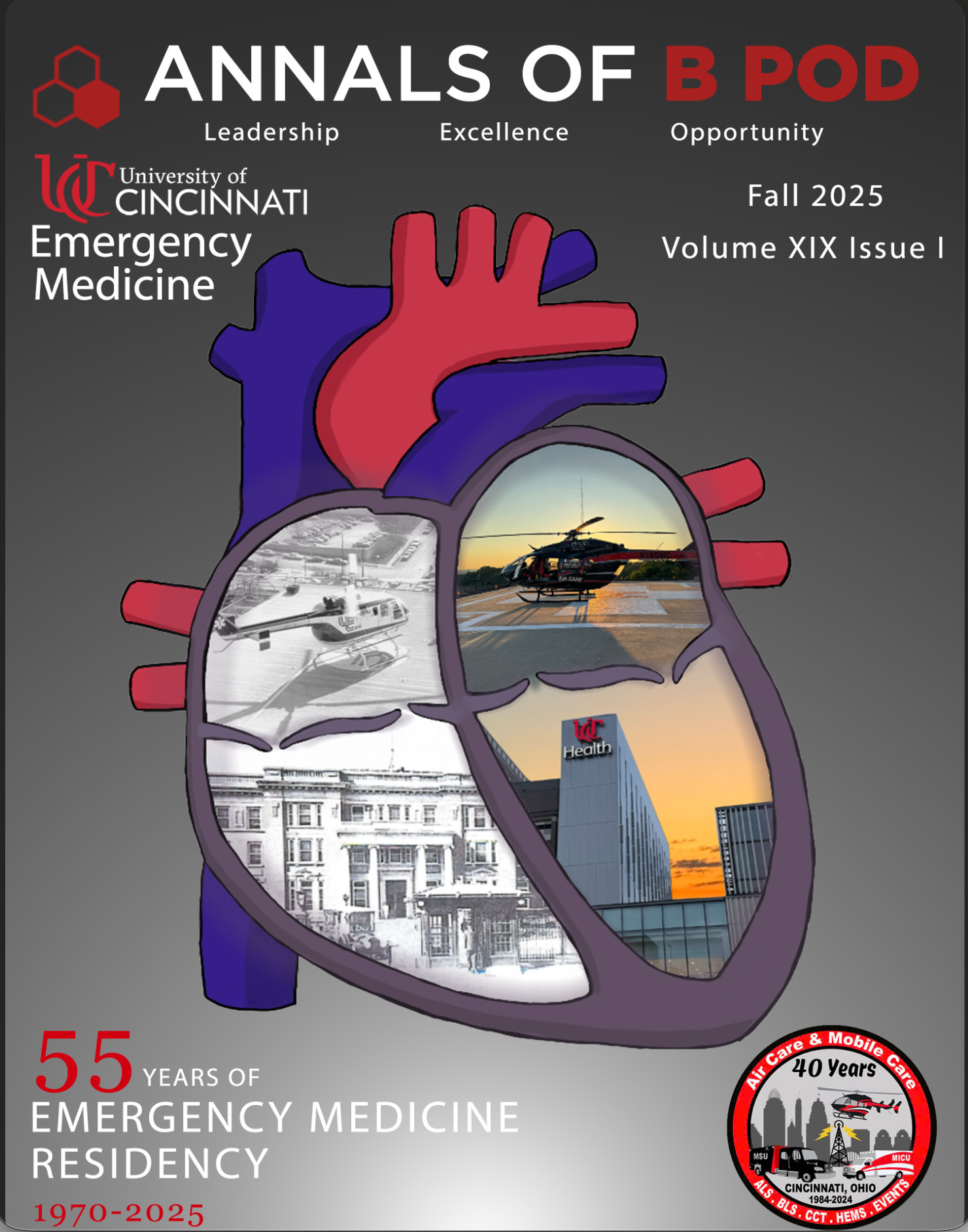
Read MoreAnnals of B Pod is a publication with a rich history that mirrors that of our department. What started as a word document of interesting cases written by Dr. Aaron Bernard (Class of 2007) in 2003 has turned into a professional publication that allows us to learn from the unique pathology our co-residents have seen. Moreover, Annals of B Pod has instilled in us a continual curiosity about how to best care for our patients, provided a creative outlet for numerous physicians, and developed many authors into accomplished academic writers. This year marks the 55th anniversary of University of Cincinnati Emergency Medicine as well as the 40th anniversary of Air Care. In this edition of Annals of B Pod, we celebrate the physicians who paved the way for our success and whose willingness to step outside the box has propelled our specialty (and manuscript) forward. To help honor our storied program, this special edition will feature previously published AOBP articles in addition to new cases. I hope this collaboration serves as a reminder of the shared experiences that have tied generations of UCEM physicians together and how far our program has come. This publication would not have been possible without the recruitment of the brightest physicians in our field and the ingenuity they demonstrated in progressing our education.
Read MorePyelonephritis is a commonly treated diagnosis in the emergency department. With resistance rates climbing to the first-line recommended fluoroquinolones and Bactrim, are other antibiotics appropriate in treating pyelonephritis? Join Dr Gabor, a PGY-3, as she discusses this article and its treatment recommendations for outpatient pyelonephritis with cephalosporins and how it compares to treatment with the more traditional fluoroquinolones / bactrim route.
Read MoreSeptic shock remains a leading cause of pediatric mortality, but the choice of first-line vasoactive agent has long been debated. Dr Newton, a PGY-3, discusses this single-center retrospective cohort study comparing epinephrine and norepinephrine as initial infusions in children with septic shock.
Read MoreCan’t remember the full physical examination of a shoulder joint? Or all the techniques and their names for reducing a dislocated shoulder? Join us for a special consultant edition of TTSRU - Dr Nana Simpson, a recent graduate of orthopedic surgery residency, and Dr Charlie Brower, a recent graduate of our EM residency, discuss a full approach to the shoulder exam and management of the dislocated shoulder. This is part 2 of a 2 part post.
Read MoreCan’t remember the full physical examination of a shoulder joint? Or all the techniques and their names for reducing a dislocated shoulder? Join us for a special consultant edition of TTSRU - Dr Nana Simpson, a recent graduate of orthopedic surgery residency, and Dr Charlie Brower, a recent graduate of our EM residency, discuss a full approach to the shoulder exam and management of the dislocated shoulder. This is part 1 of a two-part post.
Read MoreWhen a child walks into the ED with an abnormal gait, the challenge begins—not just in identifying the cause, but in knowing which limps signal something more serious. Join Dr Huang as she walks us through a structured approach to the limping child, highlighting key history and exam findings, critical diagnoses you can’t afford to miss, and the importance of considering non-accidental trauma in your workup.
Read MoreThe cornea is the window to the soul and/or retina. Given this importance it is a critical aspect of Emergency Care and why you should join Dr. Carroll on a dive into corneal pathologies you need to know.
Read MoreSRU (pronounced "shrew") = Shock Resuscitation Unit
Training in, and managing, the SRU is one of the crown jewels of our residency. It is where the sickest of the sick patients are found in our ED. It is a crucible, a test of knowledge and strength, and a true manifestation of the tripartite mission of our department: Leadership, Excellence, and Opportunity.
Training in, and managing, the SRU is one of the crown jewels of our residency. It is where the sickest of the sick patients are found in our ED. It is a crucible, a test of knowledge and strength, and a true manifestation of the tripartite mission of our department: Leadership, Excellence, and Opportunity.
Check out AI contexted information from this and other great FOAMed sites via FOAMCortex