Ode to the FOOSH
/Hand and wrist radiographs are some of the most common and most challenging x-rays to read. Take 10 minutes to watch a video and freshen up on both the anatomy and technical factors associated with wrist radiographs.
Read Moreemergency medicine tamed
Taming the SRU. The SRU is the "Shock Resuscitation Unit." It is a crucible of clinical training for the residents of the University of Cincinnati Emergency Medicine Residency training program.
Hand and wrist radiographs are some of the most common and most challenging x-rays to read. Take 10 minutes to watch a video and freshen up on both the anatomy and technical factors associated with wrist radiographs.
Read MoreBurns, bubbling airways and bradycardic arrests: all part of this week's grand rounds that brought plenty of knowledge our way. This week we heard from Dr. Dale, burn surgeon, about the latest in burn management. Dr. Carleton ran through some of his hardest airway cases for an infallable mental model of intubation. Our R3s gave a practical session on transvenous pacer placement and Dr Kircher gave us his clinical soapbox of pneumonia management.
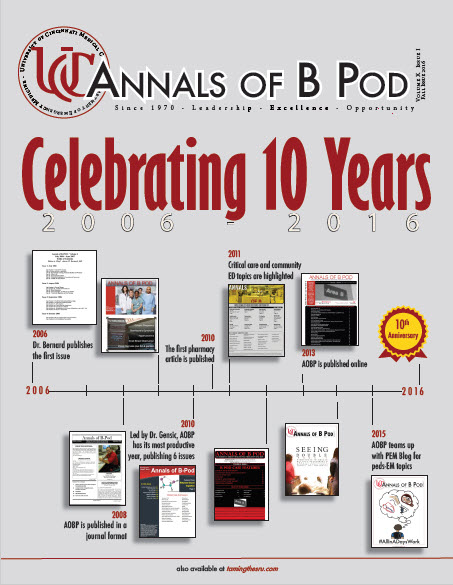
Read MoreThis issue marks the 10 year anniversary of Annals of B Pod. After 10 years and over 300 articles, Annals of B Pod continues to fulfill its initial mission of sharing the interesting case presentations, unique pathology, and diagnostic dilemmas that present to B Pod.
The time and effort put into publishing each issue by resident and faculty editors highlights their dedication to continually producing high-quality work. Each issue feels special because we, as editors, know that the publication upholds a unique and treasured tradition at the University of Cincinnati Emergency Medicine Residency. This issue feels extra special because it marks the beginning of our year-long celebration of our 10th anniversary. Over the coming year, former editors will reflect on their time in B Pod, and how sharing these experiences through Annals of B Pod shaped their career.
Read MoreNot every patient found down in front of a bar is drunk. In this case, we look at a patient whose exam didn't match his story, and discuss the Emergency Department management of Traumatic Brain Injuries.
Read MoreNot every runny nose is a viral URI. This case presents a relatively immunocompetent HIV+ male presenting with left sided rinorrhea and a fungal sinusitis diagnosed by CT. We also discuss diagnostic and therapeutic strategies for this rare diagnosis
Read MoreHave you noticed that your mood is a little worse when then sun hasn’t made an appearance in a few weeks to months? If so, you may be suffering from SAD or seasonal affective disorder.
Read MoreThis week's Grand Rounds included M&M where we learned all about bleeding and how to stop it, listened to a Case Follow-up about the Neurological Complications of Infective Endocarditis, and had lectures on BRUE, Hand Injury management in the community, and Impostor Phenomenon.
Read MoreWe seek to find diagnoses, however not infrequently we find incidental findings of unclear significance. Dr. Merriam describes a case of hers that resulted in diagnosing a pheochromocytoma and discusses the rare but serious condition.
Read MoreNSAIDs are excellent analgesics that can decrease the use of opiatess for pain, but might lead to poor healing from orthopedic injuries.
In vitro studies and rat models since the early 80s showed delayed fracture healing with NSAIDs, and the effects appeared to be dose-related. These findings have been re-demonstrated in future in vitro and rat studies as well. In humans however, the data has been, to say the least, mixed...
Read MoreThis week included our first every chalk-talk about antibiotics focusing on beta-lactams. We had our quarterly AirCare grand rounds where we learned about some special tools we carry on the aircraft including point of care lab testing and specialized suction devices. We also did a high fidelity hemorrhagic shock simulation. In two case follow-ups we learned about some special considerations in ACS and for pregnant patients in trauma. Read on!
Read More“Reason itself is fallible, and this fallibility must find a place in our logic.” - Nicola Abbagnano
Decision making in Emergency Medicine is intensely complex and it also the defining characteristic of the practice of Emergency Medicine. To outside eyes we may seem to be a specialty of action: chest tubes, intubations, heroic resuscitations with massive amounts of blood products and IV infusions. In truth none of the “action” of our specialty, the big sexy things they make into TV shows and movies, occurs without rapid, precise, and accurate thinking and decision making. But the Emergency Department can be a hostile environment to the decision making process. And, I’m not just talking about the noisy environment, the multiple interruptions, the patients with a wide variety of chief complaints and acuity seen in quick succession. There’s seemingly a thousand different hurdles between the instant a patient recognizes that something might be wrong with them and the moment a clinician diagnoses the problem.
Read MoreThis week, Dr. Palmer updated us on operations within the department, and dropped some stroke knowledge with his case follow up of altered mental status in a sickle cell patient. Drs. Scupp and Merriam presented cases on pediatric headache and hypothermia, respectively. Dr. Fananapazir tackled etiologies of fever including UTI and Kawasaki in our combined EM/PEDS lecture. We were honored to receive guest speaker Dr. Catherine Marco from Wright State University, who is senior member of the executive committee of ABEM and lectured on ethical issues of resuscitation.
Read MoreThis week we spent some time with in-situ trauma simulations, followed up by lectures on medical causes of trauma with Dr. Thompson, STEMI and aspirin allergy with Dr. Axelson and a cardiology update with our specialist of the month from our cardiology intensivity and interventionalist Dr. Tim Smith.
Read MoreThanks to all those who participated in the discussion and to those who tuned into the “Flights” cases throughout the spring and summer. The final "Flights" cases centered in on several challenging airway scenarios. Penetrating neck trauma with a tracheal injury; GSW to the face with significantly altered anatomy; and a tracheostomy displaced and a patient with critical hypoxia - airway management in the field requires a nimble mind and knowledge of one's own equipment. Take a look at our thoughts on the cases and see what you might do in similar situations.
Read MoreThis week in Grand Rounds we reviewed the morbidity and mortality cases from June and learned about infective endocarditis, intimate partner violence, tracheal injuries, pituitary adenomas, hepatic encephalopathy, epistaxis, and carfentanil - a new and dangerous adulterant in heroin. Dr. Denney was challenged to a case of dural venous sinus thrombosis. We learned about the life of an Air Force Reserve physician with Dr. Powell. Dr. Derks taught us about negative pressure pulmonary edema. Finally, we asked the question #whatsyourquestion? and reviewed how to call a good consult. Read on!
Read MoreSRU (pronounced "shrew") = Shock Resuscitation Unit
Training in, and managing, the SRU is one of the crown jewels of our residency. It is where the sickest of the sick patients are found in our ED. It is a crucible, a test of knowledge and strength, and a true manifestation of the tripartite mission of our department: Leadership, Excellence, and Opportunity.
