Three Lessons from Prehospital Evidence
The short version
Ketamine versus midazolam: No difference in field airway management was detected, but the observational comparison was confounded and imprecise.
PARAMEDIC2: Epinephrine produced much more return of spontaneous circulation and a small increase in survival, without demonstrated improvement in favorable neurologic survival.
TOWAR: Whole blood was not superior to active component therapy. The trial did not compare whole blood with no transfusion.
Prehospital research is conducted under unusual constraints. Patients often lack decision-making capacity, treatment cannot wait, and interventions must fit the operational realities of an ambulance or aircraft.
Three recent journal club papers illustrate how those constraints shape both study design and interpretation. Together, they also show why “no significant difference” can mean very different things.
Paper 1: Ketamine versus Midazolam for Acute Behavioral Disturbance
Muldowney and colleagues retrospectively examined 376 patients who received medication for acute behavioral disturbance in one urban EMS system. Of these, 162 received midazolam first and 214 received ketamine first.
The primary outcome was out-of-hospital advanced airway management after medication administration.

The absolute difference was 0.5 percentage points, with a 95% confidence interval from to percentage points. The adjusted odds ratio for ketamine versus midazolam was 1.02, with a 95% confidence interval from 0.44 to 2.38.
Those numbers do not establish equivalent safety.
Treatment was not randomized. Ketamine recipients were younger, more frequently restrained, and much more likely to have substance-associated agitation. Midazolam was used more often for postictal agitation and other medical causes. Local protocols also made intramuscular ketamine easier to give under a standing order during an immediate safety threat.
The outcome itself was imperfect. An intubation after medication may reflect respiratory depression, but it may also reflect severe trauma, asthma, seizure, hypoglycemia, or a planned airway decision.
The study also did not determine which agent controlled agitation faster or more reliably.

paper 2: PARAMEDIC2: Epinephrine Gets a Pulse—But Then What?
PARAMEDIC2 randomized 8,014 patients with out-of-hospital cardiac arrest to standard-dose epinephrine or saline placebo after initial resuscitation was unsuccessful.
The physiologic effect was striking:
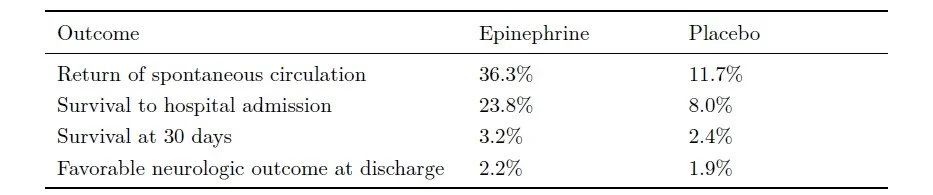
Epinephrine increased 30-day survival by approximately 0.9 percentage points. About 112 patients would need to receive epinephrine rather than placebo to produce one additional 30-day survivor.
Favorable neurologic outcome, defined as a modified Rankin Scale score of 3 or less, was not significantly different. The confidence interval remained compatible with benefit or harm.
Severe neurologic impairment was more common among survivors in the epinephrine group. That finding matters, but it does not independently prove that epinephrine caused neurologic injury. Survival was affected by treatment, so comparing only survivors conditions on a post-randomization event. Epinephrine may have enabled some patients with severe ischemic brain injury, who otherwise would have died, to survive with disability.
Timing is another important limitation. The median interval from the emergency call to the trial drug was approximately 21 minutes. PARAMEDIC2 therefore provides strong evidence about the strategy tested but does not settle the effect of much earlier epinephrine.

paper 3: TOWAR: Whole Blood versus an Active Comparator
TOWAR asked whether prehospital low-titer group O whole blood reduced 30-day mortality compared with blood components in injured patients at risk for hemorrhagic shock.
The comparator is essential. This was not whole blood versus crystalloid or no transfusion. The component strategy included red cells, plasma, or both; 57.4% of component patients received both red cells and plasma.
Forty-four air medical bases were cluster-randomized to product strategies during fixed monthly periods. Cluster randomization simplified inventory, reduced waste, and made the trial operationally feasible.
Thirty-day mortality was:

The adjusted odds ratio was 1.24, with a 95% confidence interval from 0.87 to 1.76. The trial did not demonstrate superiority of whole blood. The numerical direction favored components, although the confidence interval was too broad to establish harm.
Several factors limited treatment separation:
Approximately 32% of whole-blood-assigned patients also received components.
Some component-assigned patients received whole blood.
Blood before randomization was permitted.
The whole-blood strategy allowed only up to two prehospital units.
Subsequent hospital care was not standardized.
The trial was also powered for a large 10-percentage-point absolute mortality reduction. It was not an equivalence or noninferiority trial.
An observational substudy found no apparent mortality difference between whole blood stored for 1–14 days and blood stored for 15–21 days. Because storage age was not randomized, that finding is reassuring rather than definitive.

One Ethical Problem, Three Different Consent Models
These studies should not all be described as EFIC research.
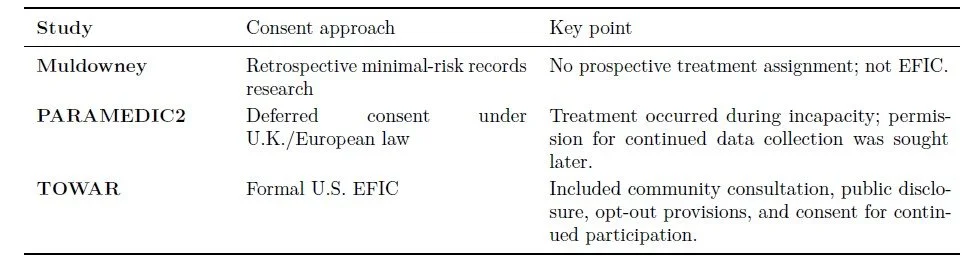
Deferred consent and EFIC address the same practical problem—a patient who cannot consent to time-sensitive research—but they arise from different legal frameworks and use different safeguards.
What Changes Tomorrow?
Agitation: Choose medication according to immediate danger, suspected cause, prior medication, route, transport conditions, local protocol, and the ability to monitor ventilation. Muldowney supports ketamine as a reasonable option, not as a proven winner.
Cardiac arrest: Continue guideline-directed epinephrine without allowing it to delay CPR or defibrillation. Describe its benefit honestly: substantially more ROSC, approximately one additional 30-day survivor per 112 treated, and no demonstrated increase in favorable neurologic survival.
Traumatic hemorrhage: Do not withhold indicated whole blood merely because TOWAR failed to show superiority over components. If both strategies are available, product selection may reasonably depend on system logistics without claiming a proven survival advantage
The Larger Lesson
The phrase “no significant difference” is not a conclusion by itself.
In Muldowney, it arose from a confounded and imprecise observational comparison. In PARAMEDIC2, a significant survival effect coexisted with an inconclusive neurologic outcome. In TOWAR, a superiority trial failed to show benefit over an active comparator.
Before changing practice, ask what was compared, how treatment was assigned, whether the outcome belonged to the patient or merely to the process, and whether the confidence interval excludes the difference that would matter clinically.
That discipline is particularly important before the bay doors, where urgency and logistics shape both the care and the evidence.
References
Muldowney M, Counts CR, Maider MC, et al. A comparison of ketamine to midazolam for the management of acute behavioral disturbance in the out-of-hospital setting. Ann Emerg Med. 2025;85(5):411–420. doi:10.1016/j.annemergmed.2024.09.003.
Perkins GD, Ji C, Deakin CD, et al. A randomized trial of epinephrine in out-of-hospital cardiac arrest. N Engl J Med. 2018;379(8):711–721. doi:10.1056/NEJMoa1806842.
Sperry JL, Guyette FX, Cotton BA, et al. Prehospital resuscitation with type O whole blood for trauma and hemorrhage. N Engl J Med. 2026;394:2317–2328. doi:10.1056/NEJMoa2602167.
Authorship
Written by: Blaine Oldham PGY-3, Elisabeth Rehfeldt PGY-3, and Thomas Sprys-Tellner PGY-3 at the University of Cincinnati Department of Emergency Medicine
Writing, Editing, Posting, and Audio Editing by Anita Goel, MD; Associate Professor, APD of UC EM Residency Program, and Co-editor of Tamingthesru.com
Editing and Posting by Haley Escheman, MPH; Program Administrator at the University of Cincinnati Department of Emergency Medicine and Co-editor of Tamingthesru.com