abnormal uterine bleeding in the non-pregnant individual
Abnormal uterine bleeding (AUB) is a common gynecologic complaint seen in the emergency department, yet the differential ranges from benign anovulatory cycles to life-threatening hemorrhage and occult malignancy. Once pregnancy has been excluded, a structured approach is essential. In this post we will explore the classification, evaluation, and emergency management of AUB in the non-pregnant patient.
Overview
Abnormal uterine bleeding (AUB) is bleeding originating from the uterus that is not associated with a patient’s normal pattern of menses. Previously, this umbrella term was classified as menorrhagia, metrorrhagia, and dysfunctional uterine bleeding (DUB). FIGO (International Federation of Gynecology and Obstetrics) has since replaced these with standardized descriptive terminology and a structured classification system. (1)
Among adult patients presenting to U.S. emergency departments between 2011 and 2019, vaginal bleeding accounted for 1.3% of all ED visits, and approximately half of these patients were identified as not pregnant. (2) In this blog post we will focus only on AUB in the non-pregnant individual as the differential diagnosis for those who are pregnant and those who are not are very different.
This post specifically focuses on reproductive age female patients. Postmenopausal women with uterine bleeding fall into a different diagnostic category and their presentation to the ED should be highly concerning for malignancy or its precursor, with need for rapid gynecology follow up.
What qualifies as normal menses?
Before labeling bleeding as abnormal, it helps to anchor to the FIGO-defined parameters of a normal menstrual cycle: (3,4)
Frequency: cycle length of 24–38 days
Duration: menstrual flow lasting ≤ 8 days
Volume: blood loss that does not interfere with a patient's quality of life
Regularity: ≤7 to 9 days variation
Deviation in any of these parameters, not just heavy volume, qualifies as AUB. Current descriptive terms include but are not limited to heavy menstrual bleeding (HMB), intermenstrual bleeding (IMB), postmenopausal bleeding (PMB) and AUB as an umbrella term; the older terms above in the overview should not appear in modern documentation.
It is very important to ask history questions to patients about their frequency, duration, volume, and regularity but also important to clarify if the menses they are presenting to the ED with is different than their usual menses in any way – i.e. is AUB their “norm” or do they usually have a very normal period (as defined by FIGO) but for their current visit they are now having AUB? Any notable change from prior menses likely requires more emergent work up and is more likely to be pathologic.
etiology
When considering a differential diagnosis for AUB in the ED patient, FIGO has categorized the causes of AUB into the mnemonic PALM COEIN to delineate structural and non-structural causes (3,4)
PALM: The Structural
Polyp - endometrial or endocervical polyp
Adenomyosis - endometrial glands and stroma within the myometrium
Leiomyomata (Fibroids) - benign smooth-muscle tumors of the uterus
Endometrial Malignancy or Endometrial Hyperplasia
COEIN: Non-Structural
Coagulopathy - von Willebrand disease and other disorders of hemostasis
Ovulatory Dysfunction – endocrine disorders (eg, thyroid dysfunction, hyperprolactinemia, PCOS), adolescence, perimenopause, and other causes of anovulation
Endometrial – primary disorders of endometrial hemostasis and local regulation of menstrual bleeding
Iatrogenic – medications or medical interventions that contribute to abnormal bleeding (eg, anticoagulants, hormonal contraceptives, intrauterine devices, and others medications/procedures)
Not otherwise listed – uncommon or incompletely characterized causes (eg, uterine arteriovenous malformations and cesarean scar defects)
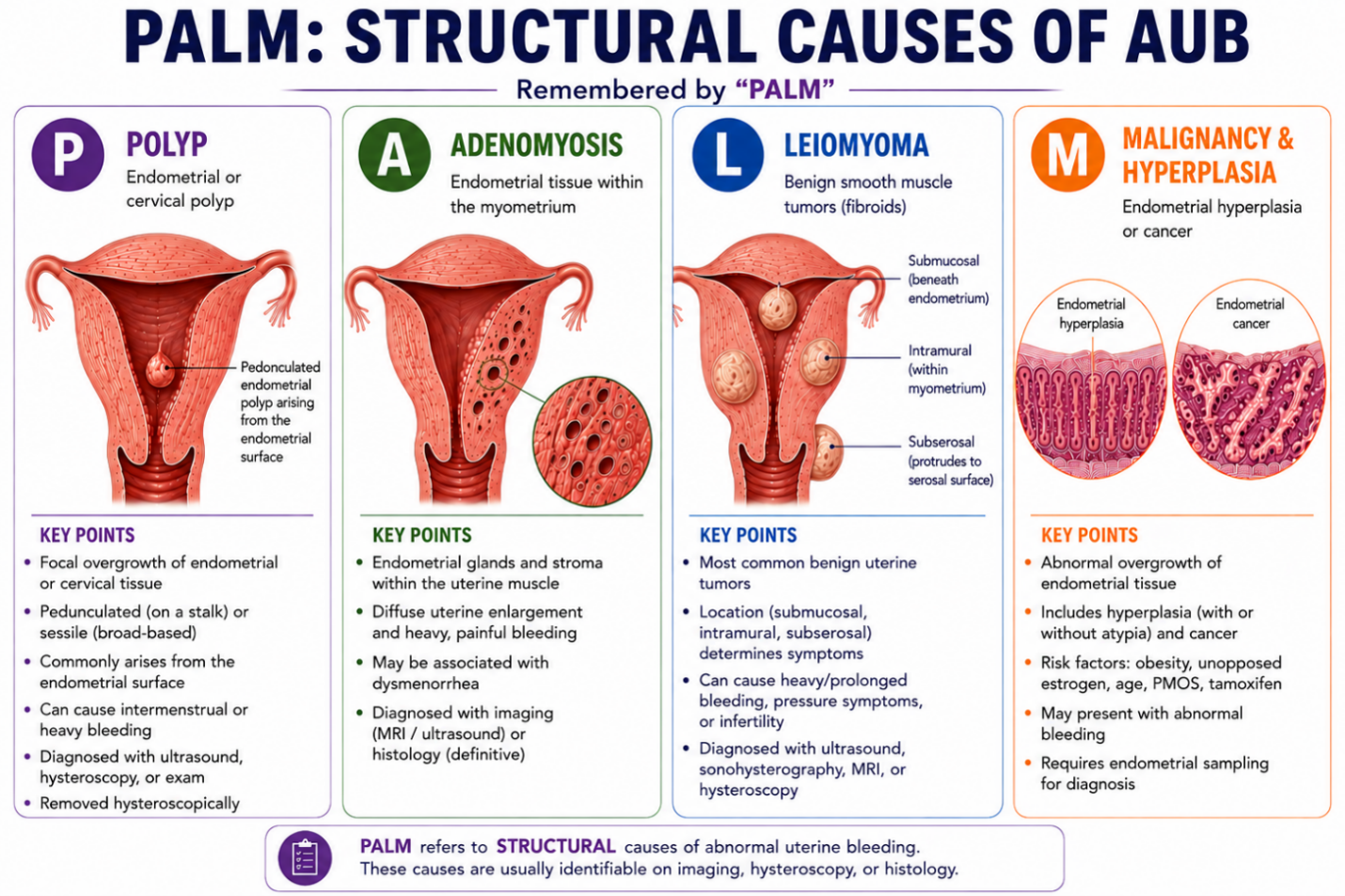
[Figure 1. PALM structural causes of abnormal uterine bleeding. Original image - AI-generated using OpenAI ChatGPT (2026).]
Clinical Presentation
Presentation will be variable depending on the cause and degree of bleeding, but certain symptoms can help delineate etiologies and severity.
Hemodynamic symptoms – dizziness, syncope, shortness of breath > Suggest symptomatic anemia
Bleeding Disorder Screening – epistaxis, easy bruising, prolonged bleeding, heavy menstrual bleeding > coagulopathy
Medication history – anticoagulants, contraceptives, hormone replacement, levothyroxine > Iatrogenic
Systemic Symptoms – weight changes, skin changes, progressive change to menses > Endocrinopathy or worsening structural
It is important on history to establish the patient’s baseline menstruation: LMP, duration, interval, number of pads/tampons usually saturated per day, and painfulness. Then compare it to the patient’s endorsed changes to better stratify if this complaint is heavy menstrual bleeding, intermenstrual bleeding or abnormal uterine bleeding broadly.
If a patient presents with overt hemodynamic instability, then transition to an ABC approach to hemorrhage and focus more broadly on stabilizing the patient and contacting gynecology early.
Diagnostics
Because evaluation of abnormal uterine bleeding may involve invasive examinations and procedures, it is important to consider which components of the workup are clinically indicated for each patient. In this section we stratify what work-up is reasonable for various patients. (5)
Every Patient
Pregnancy Test - evaluate pregnancy-related complications and determine whether pregnancy-specific management, including Rh(D) immune globulin when indicated, is required.
CBC - evaluates for anemia and thrombocytopenia for severity and possible etiology
Pelvic examination – confirm the source of bleeding and evaluate the cervix/vagina for lesions, trauma, cervicitis, or other causes
The Unstable Patient
Type and Screen - for transfusion requirement
PT/INR and aPTT – evaluate for coagulopathy when clinically indicated; obtain drug-specific anticoagulant testing (eg, anti-Xa assay) when exposure to a factor Xa inhibitor is suspected.
BMP and Hepatic Function Tests – assess for renal, hepatic, and metabolic abnormalities that may contribute to or complicate management.
The Stable but needs evaluation
Pelvic Examination additions – add STI testing when indicated by history or examination.
Transabdominal Pelvic US – noninvasive assessment for uterine enlargement, leiomyomata, adnexal pathology, and other pelvic abnormalities; particularly useful when transvaginal imaging is not appropriate or tolerated. Usually ordered as an outpatient study, to be followed up closely by gynecology.
Transvaginal ultrasound – provides higher-resolution evaluation of the uterus and adnexa than transabdominal ultrasound and is generally preferred when detailed pelvic imaging is required. Usually ordered as an outpatient study, to be followed up closely by gynecology.
TSH – consider when symptoms or history suggest thyroid dysfunction; add free T4 when clinically indicated.
Visual Field Testing – consider when hyperprolactinemia or a pituitary mass is suspected, particularly when symptoms suggest optic chiasm compression.
Management (5,7)
Unstable:
Transfusion – replacement of red blood cells and other blood components may be required and should not be neglected in those with severe blood loss.
IV conjugated equine estrogen — brisk acute bleeding when rapid control is needed and oral therapy is not appropriate; 25 mg IV q4–6h for 24 hours; avoid with contraindications to estrogen.
IV Tranexamic Acid – consider for brisk acute bleeding when rapid control is needed or oral therapy is not appropriate; 10 mg/kg IV (maximum 600 mg/dose); evidence in acute AUB is limited; avoid in patients with active thromboembolic disease and use caution when thrombotic risk is high.
Stable:
Monophasic Combined Oral Contraceptive – appropriate for hemodynamically stable patients who can tolerate oral therapy; 35 μg ethinyl estradiol q8h until bleeding is controlled; avoid when estrogen is contraindicated.
Oral Tranexamic Acid – appropriate for hemodynamically stable patients who can tolerate oral therapy; 1.3 g PO TID for up to 5 days; consider thrombotic contraindications/risk.
Medroxyprogesterone acetate – useful when estrogen is contraindicated or not tolerated; 20 mg PO TID for 7 days; bleeding control is generally slower than with IV estrogen.
Norethidone acetate- useful when estrogen is contraindicated or not tolerated; 5–10 mg PO q6h until bleeding is controlled; nausea and other progestin-related adverse effects may occur.
Many patients with AUB can be discharged home, especially if found to be stable with no significant findings on ED workup. All patients with AUB should be referred to a gynecologist for further evaluation and appropriate return precautions and emphasis on outpatient management should be explained to the patient for their safety and treatment. If a gynecology service is available to consult in the ED it may be worth consulting them for recommendations about hormone-based management options for extra security in management decisions.
Summary
In an acutely decompensated patient with AUB; hemorrhage control and blood product repletion take priority. Medications such as TXA and hormonal adjuncts are secondary efforts which can be made in conjunction with gynecologic consultation when available.
Evaluation of Abnormal Uterine Bleeding always begins with a screening for pregnancy. Laboratory evaluation in the emergency department should focus on acute reversible causes and assessment of severity.
Patient comfort is always a consideration but do not sacrifice appropriate workup for perceived patient discomfort.
When an indication for admission is not met, best practice would include an urgent referral to gynecology for further evaluation
Post by: Ryan Cain, MD
Dr. Cain is a PGY-1 in Emergency Medicine at the University of Cincinnati
Editing by: anita goel, MD
Dr. Goel is an APD in Emergency Medicine at the University of Cincinnati and Co-editor of Tamingthesru.com
CO-EDITING BY: Haley Escheman, MPH
Haley Escheman is a Program Administrator at the University of Cincinnati
References
Fraser IS, Critchley HOD, Broder M, Munro MG. The FIGO recommendations on terminologies and definitions for normal and abnormal uterine bleeding. Semin Reprod Med. 2011;29(5):383-390. doi:10.1055/s-0031-1287662.
Mooney J, Shearer E, Strauss S, Xu C, Baird J, Amanullah S. Epidemiology and outcomes of patients presenting to United States emergency departments with vaginal bleeding. West J Emerg Med. 2026;27(2):321-329. doi:10.5811/westjem.49015.
Munro MG, Critchley HOD, Fraser IS; FIGO Menstrual Disorders Committee. The two FIGO systems for normal and abnormal uterine bleeding symptoms and classification of causes of abnormal uterine bleeding in the reproductive years: 2018 revisions. Int J Gynaecol Obstet. 2018;143(3):393-408. doi:10.1002/ijgo.12666.
Munro MG, Critchley HOD, Fraser IS; FIGO Menstrual Disorders Committee. Corrigendum to “The two FIGO systems for normal and abnormal uterine bleeding symptoms and classification of causes of abnormal uterine bleeding in the reproductive years: 2018 revisions.” Int J Gynaecol Obstet. 2019;144(2):237. doi:10.1002/ijgo.12709.
American College of Obstetricians and Gynecologists' Committee on Gynecologic Practice. Management of acute abnormal uterine bleeding in nonpregnant reproductive-aged women: ACOG Committee Opinion No. 557. Obstet Gynecol. 2013;121(4):891-896. doi:10.1097/01.AOG.0000428646.67925.9a.
Panebianco N, Shofer F, O'Conor K, Wihbey T, Mulugeta L, Baston CM, Suzuki E, Alghamdi A, Dean A. Emergency department patient perceptions of transvaginal ultrasound for complications of first-trimester pregnancy. J Ultrasound Med. 2018;37(8):1965-1975. doi:10.1002/jum.14546.
Munro MG, Mainor N, Basu R, Brisinger M, Barreda L. Oral medroxyprogesterone acetate and combination oral contraceptives for acute uterine bleeding: a randomized controlled trial. Obstet Gynecol. 2006;108(4):924-929. doi:10.1097/01.AOG.0000238343.62063.22.