Annals of B Pod: Fall 2025 and Alumni Issue
/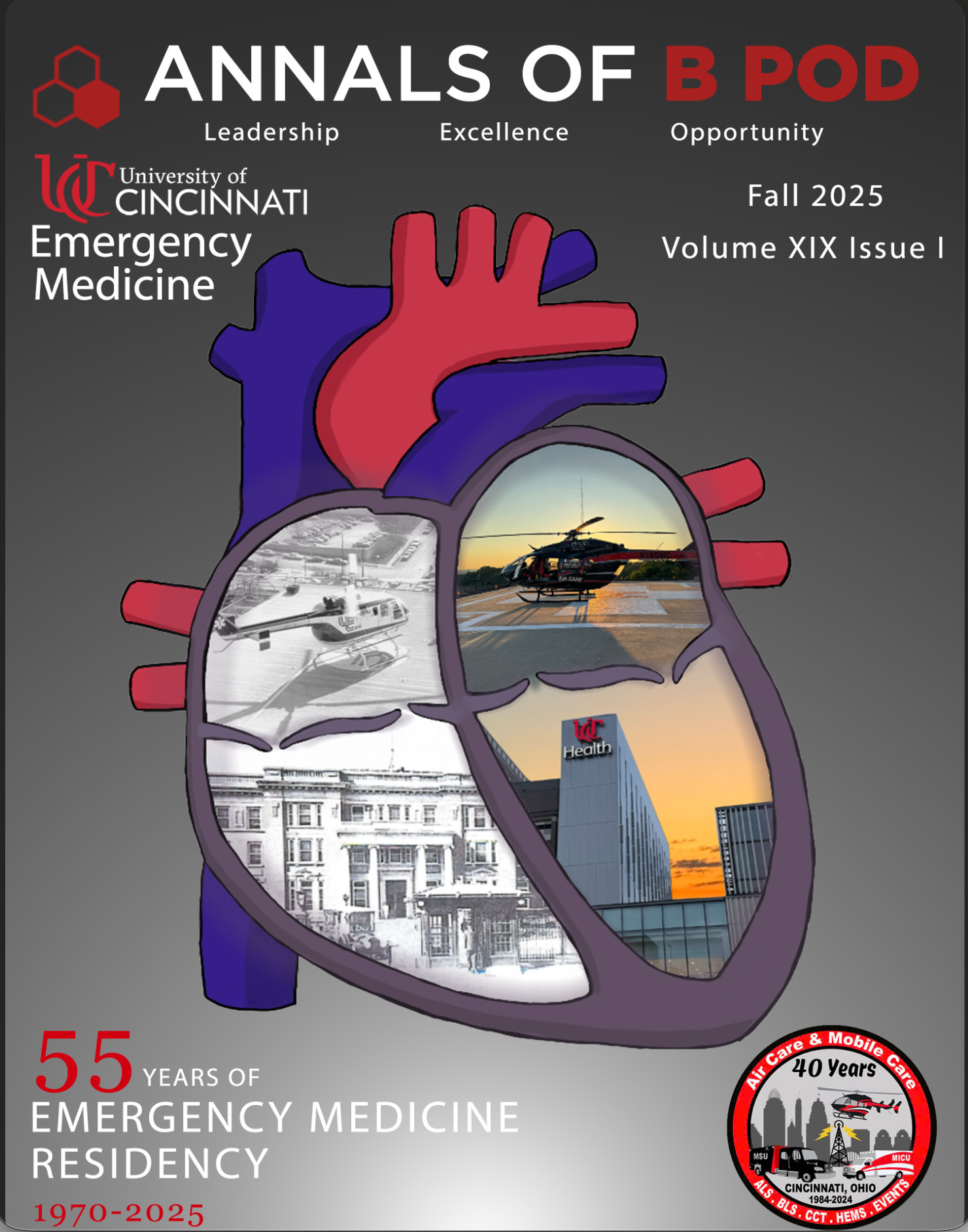
Annals of B Pod is a publication with a rich history that mirrors that of our department. What started as a word document of interesting cases written by Dr. Aaron Bernard (Class of 2007) in 2003 has turned into a professional publication that allows us to learn from the unique pathology our co-residents have seen. Moreover, Annals of B Pod has instilled in us a continual curiosity about how to best care for our patients, provided a creative outlet for numerous physicians, and developed many authors into accomplished academic writers. This year marks the 55th anniversary of University of Cincinnati Emergency Medicine as well as the 40th anniversary of Air Care. In this edition of Annals of B Pod, we celebrate the physicians who paved the way for our success and whose willingness to step outside the box has propelled our specialty (and manuscript) forward. To help honor our storied program, this special edition will feature previously published AOBP articles in addition to new cases. I hope this collaboration serves as a reminder of the shared experiences that have tied generations of UCEM physicians together and how far our program has come. This publication would not have been possible without the recruitment of the brightest physicians in our field and the ingenuity they demonstrated in progressing our education.
Read More