
Tamingthesru
Needle Cricothyrotomy
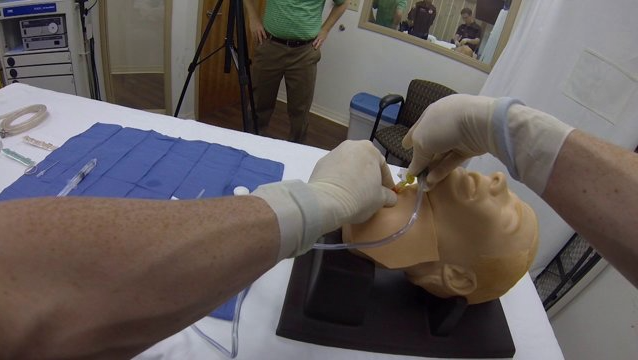
Circumstances rarely are such where we must perform a surgical airway emergently. When we do, it is always for the same indication: you have a patient that you can’t intubate AND can’t oxygenate. In most cases where a surgical airway is required, a traditional open or Seldinger technique is preferred.
In children, however, these approaches are contraindicated (most authors describe age less than 10 or so as the cut-off). Thus, the needle cricothyrotomy is a procedure that we must be prepared to perform as emergency providers as this can be done in pediatric patients.
Intubating (not in the SRU)
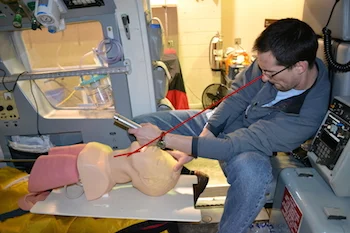
Logistics are pretty much everything. A focus on logistics is what helps UPS deliver 500,000,000 during the holiday season. A focus on logistics is what helped the Allies win World War II. But logistics doesn’t just happen on the global, macroscopic scale. Logistics plays a role in every procedure we do in the ED and in the prehospital environment. If you only focus on learning the mechanics of physically performing a procedure, you are neglecting crucial steps that will help ensure your success. In this our latest podcast in the Air Care and Mobile Care Online Flight MD Orientation, Dr. Steuerwald and Dr Hill discuss some of the complicating factors for prehospital airways, focusing on both some of the logistical issues that come into play and some of the mechanical/physical considerations.
So You Want to Tomahawk Somebody?
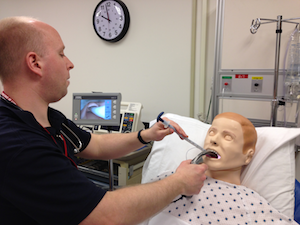
If you took a listen to our last podcast or inferred from our most recent post, the "challenging airway" that was described was managed by way of a tomahawk intubation. As we discussed in the podcast, there were a number of different ways we could have elected to manage that patient's airway including intubation from the back of the stretcher with the patient seated upright, awake fiberoptic intubation (both nasotracheal and oropharyngeal with the assistance of a Williams airway), tomahawk intubation, or, as was suggested by one of the residents (nice suggestion Dr. Cousar) after our simulation (on the same case), through a bronch adapter hooked to a LMA...