
Welcome to the new Tamingthesru
Same great content - new look - improved search

Airways, like Martinis, are Best "Dry"
Have you ever looked down the blade of a laryngoscope and said to yourself, “Damn! This airway is just too dry!” I thought not. Rather, we often look down the blade into a mucky swamp of secretions that drip from the pharyngeal walls like drool from a big, sloppy dog, and often obscure familiar landmarks and goop-up our optical and video adjuncts. Is there no solution? There is! Let us review an illustrative case...
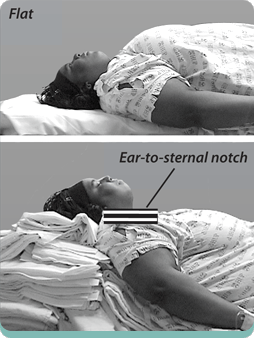
Favorite Positions!
Multiple casualties are brought to you from a house fire. There are four victims:
- A 5’11” 70 kg woman with a GCS of 8
- A 5’9” 140 kg man with circumferential burns of the chest and neck
- A 20 month-old with a pedi-GCS of 10
- An elderly, 5’6” 65 kg man with no burns, but a history of severe CHF and complaining of chest pain and dyspnea
You determine that they all require intubation for various indications. You choose RSI as the method for all except the morbidly obese patient, who you intend to intubate awake, with sedation and topical airway anesthesia.
Question:
How would you position each of these patients to optimize your chances of successful intubation on the first attempt?
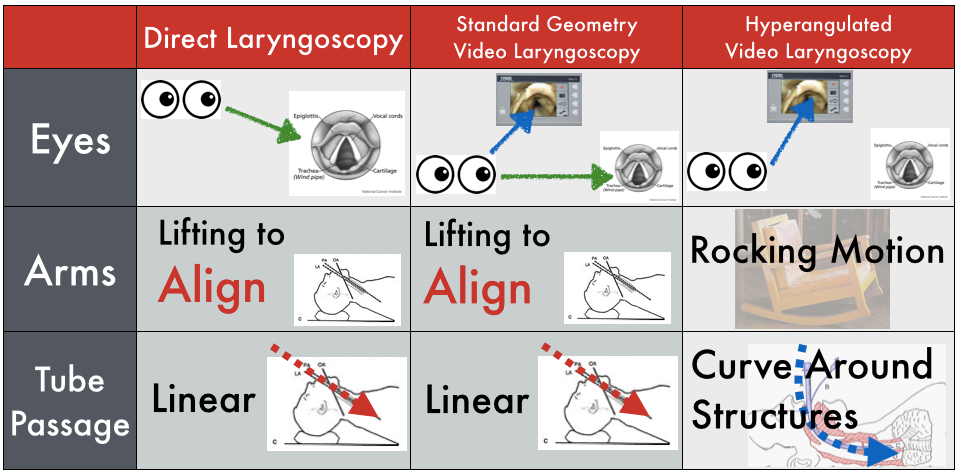
Laryngoscopy - A Definition of Terms
There can be some confusion with regards to the terminology surrounding laryngoscopy. The term "video laryngoscopy" can be used imprecisely without specific attention paid to the geometry of the blade containing the video camera. The geometry of the blade, however, is crucially important as the biomechanics of laryngoscopy differ substantially depending on whether a standard geometry (Macintosh or Miller) blade or a hyperangulated blade is used. Below you will find specific definition of terms with regards to laryngoscopy and a video demonstrating the differences between direct laryngoscopy, standard geometry video laryngoscopy, and hyperangulated video laryngoscopy.