
Welcome to the new Tamingthesru
Same great content - new look - improved search

Needle Cricothyrotomy
Circumstances rarely are such where we must perform a surgical airway emergently. When we do, it is always for the same indication: you have a patient that you can’t intubate AND can’t oxygenate. In most cases where a surgical airway is required, a traditional open or Seldinger technique is preferred.
In children, however, these approaches are contraindicated (most authors describe age less than 10 or so as the cut-off). Thus, the needle cricothyrotomy is a procedure that we must be prepared to perform as emergency providers as this can be done in pediatric patients.
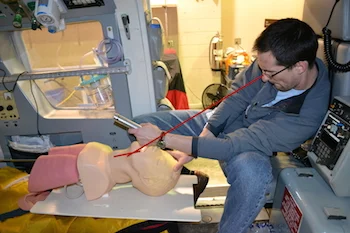
Intubating (not in the SRU)
Logistics are pretty much everything. A focus on logistics is what helps UPS deliver 500,000,000 during the holiday season. A focus on logistics is what helped the Allies win World War II. But logistics doesn’t just happen on the global, macroscopic scale. Logistics plays a role in every procedure we do in the ED and in the prehospital environment. If you only focus on learning the mechanics of physically performing a procedure, you are neglecting crucial steps that will help ensure your success. In this our latest podcast in the Air Care and Mobile Care Online Flight MD Orientation, Dr. Steuerwald and Dr Hill discuss some of the complicating factors for prehospital airways, focusing on both some of the logistical issues that come into play and some of the mechanical/physical considerations.

Pericardiocentesis
First, pericardiocentesis should be considered a temporizing procedure. In the setting of trauma, you are hoping that the pericardiocentesis will clear a small amount of blood from the pericardial space and remove any tamponade the might be present. It is likely, however, because of the mechanism of injury, that blood will again rapidly accumulate leading to recurrent tamponade physiology. Ultimately (but not on Air Care — DON’T do a clamshell), these patients will need a pericardial window, exploration, and repair of whatever injury is causing the accumulation of blood.